


What is the difference between 8-bit and 10-bit video?
The difference is the number of color levels each channel can represent. 8-bit records 256 brightness levels per color channel (16.7 million colors total). 10-bit records 1,024 levels per channel (1.07 billion colors). This 4x increase makes a dramatic difference when color grading.
Why 10-bit matters for color grading
When you apply a color grade or exposure adjustment, you are stretching and remapping tonal values. With only 256 levels (8-bit), even moderate adjustments create visible banding — step-like transitions in skies, skin tones, and backgrounds.
10-bit gives you 1,024 levels — 4x more data. Heavy color grading that would destroy 8-bit footage remains smooth and natural in 10-bit.
This is especially critical for Log footage. Log profiles compress dynamic range into a flat curve that needs aggressive grading. Without 10-bit, the grading introduces artifacts.
When 8-bit is fine
For content going straight to YouTube, Instagram, or TikTok with minimal color adjustment, 8-bit is perfectly adequate.
If you use in-camera picture profiles (not Log) and keep grading minimal, 8-bit delivers great results.
8-bit files are also smaller and easier to edit on less powerful computers — a practical advantage for creators on laptops.
10-bit cameras at Camera Shop Egypt

Canon EOS R5 C Mirrorless Cinema Camera
Available on backorder
| Sensor | Full-Frame 45MP CMOS |
|---|---|
| Megapixels | 45 MP |
| Video Resolution | 8K60 RAW / 4K120 |
| Video Format | 12-Bit Cinema RAW Light, JPEG, C-RAW |
| Autofocus | Dual Pixel CMOS AF II with Eye, Face, Head & Animal Detection, 1053 AF Zones |
| Continuous Shooting | Up to 20 fps |
| Mount | Canon RF (EF compatible via adapter) |
| Memory Slots | CFexpress Type-B + SD UHS-II Dual Slot |
| Recording Time | Unlimited Internal Recording |
| Connectivity | Wi-Fi (5GHz / 2.4GHz), Bluetooth, Timecode DIN Port, Multi-Function Shoe, HDMI RAW Output |

Sony a7S III Mirrorless Camera
In stock
| Sensor | 12.1MP Full-Frame Exmor R BSI CMOS (Back-Illuminated) |
|---|---|
| Megapixels | 12.1 MP |
| Video | UHD 4K 120p, 10-Bit 4:2:2 Internal, 16-Bit RAW Output, up to 600 Mb/s |
| ISO Range | 80-102400 (Extended: 40-409600) |
| Autofocus | 759-Point Fast Hybrid AF (Phase + Contrast Detection), covers 92% of frame, down to -6 EV |
| Image Stabilization | 5-Axis SteadyShot In-Body Image Stabilization |
| Viewfinder | 9.44m-Dot QXGA OLED Electronic Viewfinder |
| Screen | 3.0-inch 1.44m-Dot Vari-Angle Touchscreen LCD |
| Continuous Shooting | 10 fps, up to 1000 Uncompressed RAW Files |
| Storage | Dual CFexpress Type A / SD Card Slots |
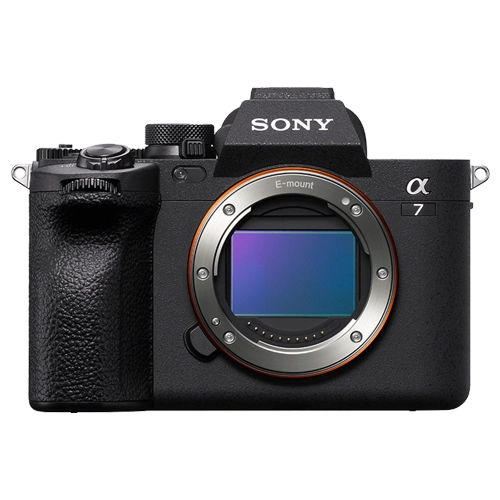
Sony a7 IV Mirrorless Camera
In stock
| Sensor | 33MP Full-Frame Exmor R BSI CMOS |
|---|---|
| Megapixels | 33 MP |
| Processor | BIONZ XR |
| Video | 4K 60p 10-Bit, S-Cinetone, S-Log3, XAVC HS / XAVC S-I up to 600 Mb/s |
| ISO Range | ISO 100–51200 |
| Autofocus | 759-Point Fast Hybrid AF, Real-Time Eye AF, -4 EV sensitivity, ~94% coverage |
| Image Stabilization | 5-Axis SteadyShot In-Body |
| Continuous Shooting | Up to 10 fps (mechanical or electronic shutter, AF/AE on) |
| Viewfinder | 3.68m-Dot EVF, 120 fps Refresh Rate |
| Screen | 3-inch 1.03m-Dot Vari-Angle Touchscreen LCD |
| Mount | Sony E-Mount (Full-Frame) |
| Connectivity | 4K 15p UVC/UAC Live Streaming via USB Type-C |
10-bit internal vs external
10-bit internal means the camera records 10-bit directly to its memory card. Most convenient and now standard on cameras above entry level.
10-bit external means the camera outputs 10-bit via HDMI to an external recorder. Some older or budget cameras only support 10-bit externally.
Always check whether your camera does 10-bit internally — external recording adds cost, bulk, and complexity.
If you plan to color grade your video at all — even basic white balance or exposure tweaks — 10-bit internal recording should be a requirement when choosing your next camera.